
The Elegant Cavalier
The tactical genius who fought for player rights and reshaped modern cricket

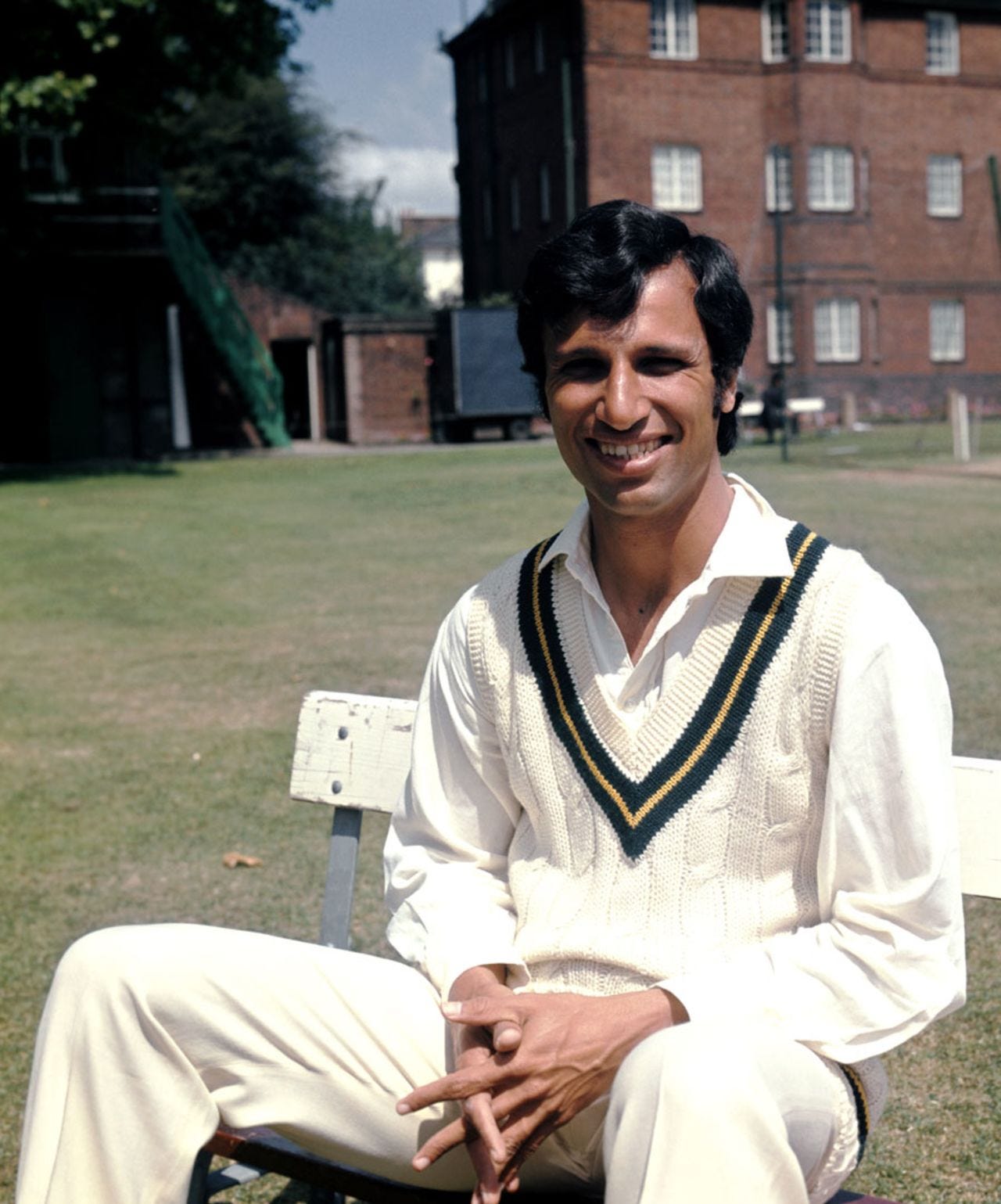
The story of Asif Iqbal Razvi is far more than a collection of runs and wickets. His life and career read like a sweeping narrative of post-Partition South Asian history, highlighting a unique cross-border identity, a radical technical change, and a pioneering drive for player rights that forever changed the business of cricket. Known for his charismatic elegance on the field and sharp, progressive mind off it, Asif Iqbal left an indelible mark on international cricket.
Ancestral Roots and the Cross-Border Transition
Born on June 6, 1943, in Hyderabad, India, Asif Iqbal grew up in a prominent Muslim family with a rich athletic pedigree. He was the nephew of Ghulam Ahmed, the legendary off-spinner who captained India in the 1940s and 1950s. Decades later, this sporting family tree would expand even further across borders, linking him distantly to Indian tennis icon Sania Mirza, who married former Pakistani captain Shoaib Malik.
Unlike many who migrated immediately during the 1947 Partition, Asif spent his entire youth in independent India. He studied at Madrassa-e-Aliya and Osmania University, making his first-class debut in the Ranji Trophy during the 1959–60 season under the captaincy of M. L. Jaisimha.
The turning point of his young life came in January 1961. Playing as an 18-year-old medium-pacer for India’s South Zone against a touring Pakistan national team, he claimed six wickets. The Pakistani captain, Fazal Mahmood, was so deeply impressed by the teenager’s poise that he convinced Ghulam Ahmed that the boy’s cricketing future would shine brighter in Pakistan, where most of his extended family had already moved.
Late in 1961, the family moved to Karachi. This pre-1965 migration happened at a time when cross-border movement was still relatively fluid. In Karachi, Asif completed his studies at SM College and quickly embedded himself into the local cricket scene, eventually playing for the powerhouse Pakistan International Airlines (PIA) team.
From New-Ball Bowler to Strokeplay Master
When Asif made his Test debut for Pakistan against Australia in October 1964, he was viewed strictly as a bowling all-rounder. In a fascinating historical footnote, he opened the bowling alongside another future batting legend, Majid Khan, while slotted to bat down at number ten. His early value lay in his right-arm medium-fast swing, which yielded consecutive five-wicket hauls on a winter tour of New Zealand.
However, ahead of the 1967 tour of England, Asif developed a severe, debilitating back condition. Realising that his body could no longer handle the physical strain of opening the bowling, he made a bold decision: he would completely reinvent himself as a specialist batsman. It was a transformation his uncle Ghulam Ahmed had poetically foreseen years earlier, gifting a young Asif a pair of batting gloves and predicting that his true future lay with the willow.
As a batsman, Asif became one of the most exhilarating and stylish stroke-makers of his generation. He possessed exceptionally nimble footwork, flexible wrists, and a gorgeous, fearless cover-drive. He batted with a restless, athletic energy. While his stance was slightly unconventional—wearing pads with massive flaps that combined with a natural bow-leggedness to give him a cowboy-like stride—his actual shot-making was pure poetry.
Rearguard Masterclasses in Test Cricket
Asif Iqbal’s international reputation was forged in the fires of team crises. He became Pakistan’s ultimate specialist in the impossible, saving or winning matches when all hope seemed lost.
The Oval, 1967
Staring at a crushing innings defeat against England, Pakistan was reduced to a horrific 53 for 7 in their second innings. Walking in at number nine, Asif played a knock of pure genius and joyful defiance. He smashed 146 runs in just 200 minutes, hitting 21 fours and two sixes. Alongside Intikhab Alam, he put on a world-record 9th-wicket partnership of 190 runs. His century sparked an affectionate pitch invasion by ecstatic Pakistani fans who carried him shoulder-high, earning him a selection as a Wisden Cricketer of the Year in 1968.
Dunedin, 1973
Against New Zealand at Carisbrook, Asif registered his highest Test score of 175. Joining Mushtaq Mohammad at the crease, the duo launched a spectacular post-lunch assault, scoring 316 runs in the final four hours of Day Two. Their fifth-wicket partnership yielded 350 runs, setting a Pakistani record that stood for a decade and anchoring an innings victory.
Adelaide and Sydney, 1976–77
In Adelaide, Asif shielded the tail with a gritty, unbeaten 152 to secure a dramatic draw. Just a few weeks later in Sydney, he played what he considered his finest innings. Coming in at number six, he scored a brilliant 120 against a fierce Australian attack, giving Pakistan a vital first-innings lead that secured their historic, first-ever Test victory on Australian soil.
The Kent Odyssey and Leadership Legacy
Asif’s relationship with Kent County Cricket Club spanned fifteen incredibly successful years (1968–1982). An early slump in 1969 saw him dropped to the second XI. Having grown up playing cricket largely as an amateur pastime, he hadn’t fully grasped the weekly grind of English county cricket. A firm, career-defining talk with Kent manager Les Ames transformed his mindset into that of a disciplined professional.
He went on to help Kent win the 1970 County Championship, famously taking a spectacular running catch to seal the title. In 1977, he made history by becoming Kent’s first overseas captain, ultimately winning ten major trophies with the club.

Beyond county cricket, Asif was a brilliant tactical leader. He captained Pakistan to the semi-finals of the 1979 World Cup, putting on an exceptional all-round display against the West Indies, where he took four for 56, dismissing Greenidge, Haynes, Richards, and Lloyd.
The Packer Revolution and the Birth of Modern Cricket
When Australian media tycoon Kerry Packer launched World Series Cricket (WSC) in 1977, it shook the foundations of the sport’s conservative establishment. Frustrated by broadcasting disputes, Packer secretly signed over fifty of the world’s finest cricketers to a private, breakaway league. His pitch was simple: pay players what they were truly worth. At a time when international stars were treated as poorly compensated amateurs by their national boards, Packer offered financial security and true professional contracts. Asif Iqbal, who was already leading the fight for better player wages in Pakistan, was a natural recruit, joining an elite, hand-picked World XI squad alongside legends like Tony Greig and Barry Richards.
The cricket establishment reacted with fury, slapping immediate bans on WSC players and labelling them “rebels.” However, Packer funded a landmark legal battle in London’s High Court, which ultimately ruled that the sweeping bans constituted an unreasonable restraint of trade. Vindicated, the players won the legal right to represent both the WSC and their national teams. Though WSC lasted for only two intense seasons between 1977 and 1979, it completely revolutionised the sport by pioneering night cricket under floodlights, colored clothing, white balls, and high-quality, multi-camera television coverage.
Asif featured prominently in WSC’s highly competitive matches, playing five gruelling “Supertests” and numerous short-format fixtures against lethal bowling attacks. For him, the “Packer Circus” was more than just a lucrative playing stint; it was a masterclass in modern sports promotion and player leverage. It proved that cricket was a highly viable commercial entertainment industry—a crucial lesson Asif would directly apply just a few years later when he transitioned from the pitch to become the chief administrative architect of Sharjah.
Pioneering Player Rights and the Sharjah Era
Perhaps Asif’s greatest legacy is his role as a pioneer for player advocacy. In the mid-1970s, international cricketers were poorly paid and treated as subservient by authoritarian boards. Alongside Mushtaq Mohammad and Imran Khan, Asif led a major pay revolt against the BCCP, then run by A.H. Kardar. Despite being labelled “mercenaries” and threatened with a total ban, the players stood firm, forcing Kardar’s exit and securing substantial pay raises. This desire for professional respect had naturally aligned him with Packer’s vision, setting a brand-new precedent for player power in the sport.
After retiring following a bittersweet 1979–80 tour of India—where he received a legendary standing ovation at Eden Gardens but faced interpersonal friction within the squad—Asif turned his financial and administrative acumen toward sports promotion. He co-founded the Cricketers Benefit Fund Series (CBFS) in Sharjah with UAE businessman Sheikh Abdul Rahman Bukhatir. Under his guidance, Sharjah became a thriving, neutral ODI oasis that raised substantial benefit purses for retired subcontinental cricketers.
A Bitter Shadow: The rapid commercialisation of the game brought immense scrutiny. When the match-fixing storm broke in 1999–2000, allegations surfaced regarding his 1979–80 captaincy. Asif vigorously defended his integrity from London. He was completely cleared of any wrongdoing by major international investigations, receiving signed letters of clearance from the ICC and PCB, and was later welcomed as an honoured guest at the BCCI’s CK Nayudu Awards in 2006.
Conclusion
Asif Iqbal’s impact on cricket extends far beyond simple numbers. He was instrumental in transforming the subcontinental cricketer from an underpaid amateur into a self-respecting professional partner. His early embrace of limited-overs cricket and his pioneering work in building Sharjah laid the structural groundwork for the modern, commercialised white-ball game we see today. Settled in London in his later years, the 1968 Pride of Performance recipient remains one of the most stylish, progressive, and historically transformative figures to ever emerge from the subcontinent.